Book Reviews
-

Art Style Editions: Exploring Black Resistance: The Inner Passage Uncovered
“The Inner Passage has been recognized for its intertwined layers of rigorous research, environmental awareness and poetic visual language. Yet Richards resists a didactic reading. “I want people to experience it as a visual poem,” she says, “to feel—through the land, the trees, the water—the sense of place, and the power of the landscape telling its own history.””
Read the review here. -

Amateur Photographer: Virginia Richards on The Inner Passage and Photographing the Water Ways
“A librarian pointed her towards old maps and plates. There, on a map from the early 1700s, Richards found the words New Cut marked exactly where she had been swimming. ‘The lack of information really intrigued me and piqued my curiosity,’ she says. ‘I really did want to learn the history of this place that has no written history.’”
Read the story here. -

Black+White Photography, Issue #315, Feature: “The Land Remembers”
“McGee Richards’ new book, The Inner Passage, brings together her photographs of landscapes altered by slavery and portraits of Lowcountry descendants, all taken using wet-plate collodion, a mid-19th-century photographic process used by the Civil War photographer Matthew Brady.”
-

Lenscratch, Review: The Inner Passage
“Throughout the book, Richards demonstrates a commitment not only to understanding this history but also to understanding the people and landscapes that continue to carry it into the present…”
Read the review here. -
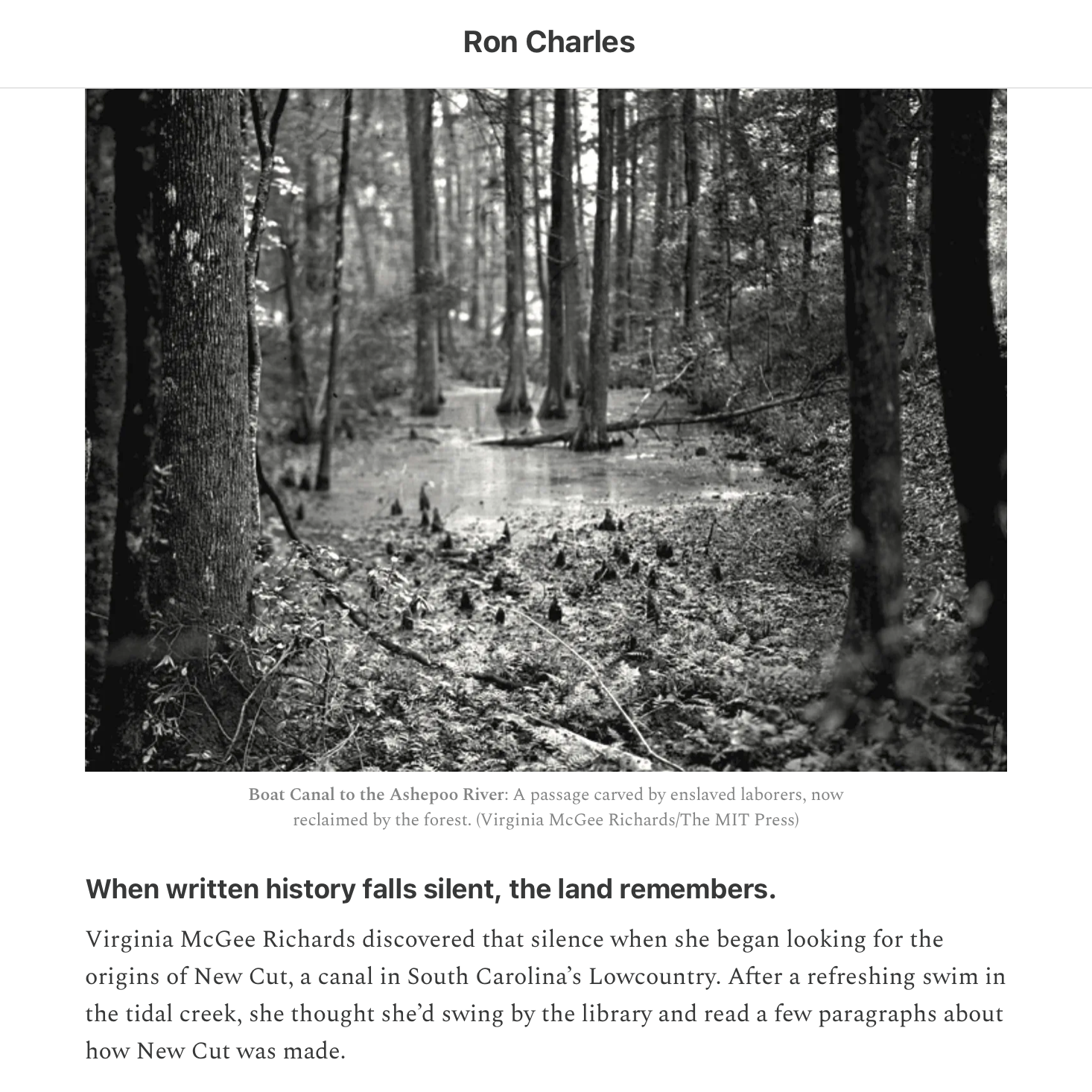
Ron Charles’ Substack, Review: The Inner Passage
Ron Charles, former editor of Washington Post Book World, reviewed The Inner Passage in his Substack.
“When written history falls silent, the land remembers.
Virginia McGee Richards discovered that silence when she began looking for the origins of New Cut, a canal in South Carolina’s Lowcountry.”
-

Foreword, Review: The Inner Passage
“The images have a timeless, sometimes ghostly, quality that connects the past and present. In some, live oaks or “witness trees” tower over the islands after hundreds of years, their leaves looking like a mist in the colorless images. Old canals still connect lowland areas, and former plantation homes and loose cinderblocks look like ancient ruins reclaimed by nature.”
-

Conscientious Photography Magazine, “The Inner Passage”
“My first exposure to the idea that the land was not merely some immutable background people were operating against came from the very place I grew up in: the part of the city where I was born had been wrested (“reclaimed”) from the sea.”
-

Hyperallergic, “10 Art Books for your Spring Reading List”
“There is a waterway in the South Carolina Lowcountry that swells with centuries-old untold stories. Called the Inner Passage, it was dug by enslaved people to serve plantations, but by the grace of history’s irony, it also helped them escape to their freedom in the Spanish Florida.”
-

Garden & Gun, “A Charleston Historian Used an Antique Photography Method to Blur Past and Present, with Stunning Results”
“‘The Inner Passage,’ Virginia McGee Richards’s new book and photo project, shines an otherworldly light on a canal system dug by enslaved hands.”
Read the article here. -

Charleston Mercury, Review: The Inner Passage
“Portraits like fisherman-artist Sherman Mack, who docks his boat in the Inner Passage and paints its gravestone-dotted shores, tracing his lineage, or Kathy Holmes, linking six generations to 1830s James Island matriarch Molly Fludd — whose clan still gathers annually to honor the passage — breathe life into this poetic archive.”
-

New Books Network Book of the Day
“Some of the earliest canals in colonial America, referred to as the Inner Passage, were constructed by enslaved people living in the Lowcountry of South Carolina in the early 1700s. In a paradox of history, for over a hundred years enslaved Black people used these canals, constructed for white plantation owners, to travel southward to freedom in Spanish Florida.”